










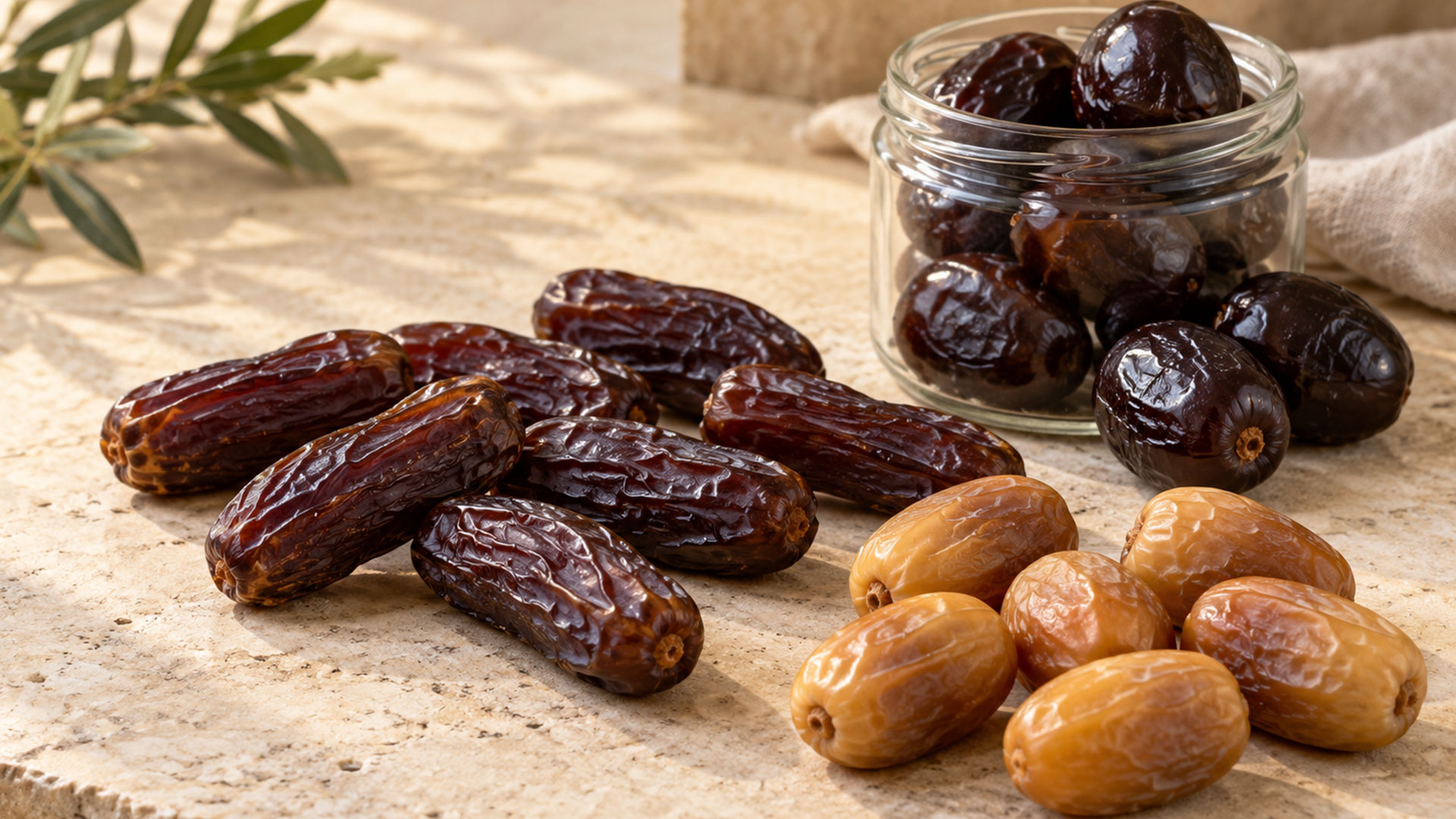
Mazafati vs Piarom vs Zahedi Dates for Importers
Choosing among Mazafati, Piarom, and Zahedi dates can change far more than the flavor profile of an import program. Each variety brings a different combination of texture, moisture, appearance, storage behavior, and market position. For buyers comparing Mazafati vs Piarom vs Zahedi dates for importers, the practical question is which product fits the intended sales channel, packaging format, transit conditions, and inventory cycle without creating avoidable quality or handling problems.
A closer match between product characteristics and the route to market makes purchasing decisions easier to defend. JAM Food Co. lists Mazafati, Piarom, and Zahedi among its date products, giving importers one contact point for inquiries about the three products. Buyers can use the company’s inquiry and quotation channels to request current specifications, packaging details, storage instructions, and availability for the variety that best suits their customers.
Mazafati, Piarom, and Zahedi dates at a glance
The most useful starting point is the physical character of each variety. Mazafati dates are generally associated with soft, moist fruit, while Piarom has a firmer dry or semi-dry character. Zahedi, also spelled Zahidi, is typically dry to semi-dry and lighter in color. Research confirms meaningful differences among date cultivars, although moisture, firmness, and composition still vary with origin, maturity, processing, and storage.
| Commercial criterion | Mazafati | Piarom | Zahedi |
| General texture | Soft, fleshy, and moist | Firm and chewy | Firm, relatively dry, and less sticky |
| Typical color | Dark brown to black | Dark brown | Golden yellow to light brown |
| Common presentation | Soft premium date | Premium semi-dry or dry date | Practical dry or semi-dry date |
| Likely handling demand | Greater moisture sensitivity | Generally easier to handle than soft dates | Suited to less sticky bulk handling |
| Common commercial fit | Chilled retail, specialty stores, and food service | Premium retail, gifting, and specialty distribution | Volume distribution, retail, and processing |
| Main purchasing concern | Temperature control and package protection | Grade consistency and presentation | Size, dryness, defects, and processing suitability |
These descriptions indicate broad tendencies rather than guaranteed shipment specifications. A peer-reviewed study categorized its Mazafati sample as soft, Piarom as dry, and Zahedi as dry to semi-dry, but its measurements applied to particular samples and harvest conditions. Importers still need a current specification for the offered lot instead of assuming that every product sold under a cultivar name has the same moisture, firmness, size, or storage behavior.
How the three date varieties differ in trade
The differences become more useful when they are connected to the buyer’s business model. Texture affects package presentation, compression resistance, processing behavior, and consumer expectations. Moisture influences handling and storage risk, but it does not determine commercial suitability on its own. Grade, maturity, package barrier, sanitation, transport conditions, and stock rotation can change how well any of the three varieties performs after arrival.
Mazafati: a soft date for moisture-sensitive supply chains
Mazafati dates are commonly recognized by their dark brown to black appearance and soft, fleshy texture. They are often marketed at the Rutab stage, when the fruit retains more moisture than a fully dried date. That character can support a tender eating experience and an attractive specialty-retail proposition, but it also makes the delivered condition more dependent on packaging integrity, temperature stability, and careful handling.
For importers, Mazafati is most relevant when customers actively want a soft date and the distribution system can protect that quality. Retailers may value its dark appearance and moist texture, while restaurants and food-service businesses may prefer the tender flesh. Long ambient journeys, repeated temperature changes, weak cartons, or slow inventory turnover can be less compatible with a soft product unless the supplier has validated the complete packing and transport system.
Piarom: a firmer option for premium presentation
Piarom dates generally have an elongated form, dark color, thin skin, and firm, chewy flesh. They are commonly described as dry or semi-dry, depending on the source and product condition. This lower-moisture character distinguishes Piarom from soft Mazafati and may support cleaner handling, stronger visual presentation, and greater flexibility in retail packs where buyers want individual fruits to retain their shape.
Piarom is frequently positioned for premium retail, specialty stores, and gift assortments. That position should not be treated as a universal grade or price guarantee. Fruit size, skin condition, color uniformity, defects, crop year, packaging, and lot consistency all influence its commercial value. An importer comparing Piarom offers needs measurable acceptance criteria, especially when the selling proposition depends on appearance and a higher retail price point.
Zahedi: a practical date for volume and ingredient applications
Zahedi dates, also known as Zahidi, are usually golden yellow to light brown with firm, dry or semi-dry flesh. Their appearance makes them easy to distinguish from dark Mazafati and Piarom lots. The relatively low stickiness commonly associated with Zahedi can be useful in bulk handling, repacking, pitting, chopping, and ingredient preparation, although processing performance still needs to be checked against the actual specification.
Zahedi may suit importers serving mainstream retail, wholesale distribution, bakeries, snack manufacturers, or other ingredient users. Its commercial appeal is often linked to practicality rather than luxury positioning. That does not make every Zahedi lot interchangeable. Size distribution, pit removal, moisture, surface condition, foreign matter, infestation, and flavor can affect yield and usability. Manufacturers should define processing requirements that go beyond the standards written for whole dates sold directly to consumers.
Comparison: logistics, storage, and quality control
The choice among these varieties often becomes clearer when the importer looks beyond the purchase price. A product that needs tighter temperature management, smaller packs, faster rotation, or more protective cartons can produce a different landed cost from a firmer date handled under a simpler system. Storage guidance must still come from the supplier’s documented conditions because cultivar names alone do not establish a shipment’s shelf life.
Moisture and temperature management
Moisture is closely connected to texture and postharvest behavior. The UC Davis Postharvest Research and Extension Center notes that higher-moisture dates respire more quickly and that soft cultivars generally have shorter storage potential than semi-soft cultivars. It also identifies fermentation, mold, moisture absorption, insect activity, and darkening as relevant concerns. These principles explain why moist Mazafati normally demands more attention than firmer Piarom or Zahedi.
That difference does not justify one universal transport temperature for every lot. Packaging, maturity, route duration, pre-shipment treatment, destination climate, and the supplier’s shelf-life validation all matter. Piarom and Zahedi may tolerate distribution differently from Mazafati, but “semi-dry” does not mean unaffected by heat or humidity. Temperature fluctuations can cause condensation, while unsuitable humidity can either dry the fruit or allow it to absorb moisture from the surrounding air.
Packaging, compression, and inventory turnover
Packaging has to protect the intended character of the fruit. Soft dates can be vulnerable to crushing, leakage, and loss of presentation when too much weight rests on the lower layers. Firmer dates may tolerate bulk handling better, but they still need protection from moisture exchange, pests, contaminants, strong odors, and physical damage. Pack size should therefore reflect both transport conditions and the rate at which customers will use or sell the product.
Shelf life should be expressed with defined conditions rather than as an isolated number. The same variety may behave differently in a sealed retail pack, a lined bulk carton, or an opened working container. Importers need to know what the stated period assumes about temperature, humidity, packaging, and opening. They also need enough remaining life after customs clearance, inland delivery, warehousing, and retail distribution to support the planned inventory cycle.
Grading, defects, and lot acceptance
Appearance-based descriptions are useful for presenting each variety, but commercial acceptance needs measurable criteria. The Codex Standard for Dates covers maturity, characteristic color and flavor, moisture limits, minimum size, pits in pitted dates, mineral impurities, infestation, and defined defects. UNECE’s revised standard document for dates also addresses commercial quality, classification, sizing, tolerances, presentation, and marking.
Codex applies to commercially prepared whole dates packed for direct consumption. It does not cover date pieces, mashed dates, or dates intended for industrial purposes. A manufacturer buying Zahedi for chopping or another variety for paste may therefore need requirements addressing process yield, pit fragments, cut performance, particle size, or other application-specific factors. A shared quality label such as “premium” cannot replace an agreed written specification.
A purchase specification can define comparable criteria across the three varieties:
- Cultivar name and accepted spelling
- Crop year, lot identity, and declared origin
- Maturity stage and pitted or unpitted style
- Moisture range and measurement method
- Fruit count, weight, or size category
- Color, firmness, and skin condition
- Limits for damaged, unripe, fermented, moldy, or pest-affected fruit
- Limits for pits, pit fragments, and foreign material
- Packaging materials, unit weight, and carton configuration
- Storage conditions and the basis of the stated shelf life
- Sampling, inspection, and rejection procedure
Which variety fits each sales channel?
No variety is the strongest option for every importer. Mazafati’s softness may be an advantage in a chilled specialty range but an operational burden in a long, uncontrolled distribution chain. Piarom can support premium presentation when buyers accept its commercial position and verify the grade. Zahedi can offer handling and processing advantages where appearance, firmness, and lower stickiness matter more than a moist eating texture.
Common use-case matches include:
- Premium chilled or specialty retail: Mazafati may fit customers who expect dark, soft, moist fruit and can maintain appropriate storage conditions.
- Premium retail and gifting: Piarom may suit specialty packs that favor a dark, elongated, firmer date.
- Mainstream wholesale distribution: Zahedi may offer practical handling for buyers moving larger quantities through longer inventory cycles.
- Food manufacturing: Zahedi can be relevant for pitting, chopping, baking, or ingredient use, subject to process trials and specifications.
- Food service: Mazafati may suit applications where tenderness is valued, while firmer varieties can offer cleaner portioning and handling.
- Mixed product portfolios: Carrying more than one variety can serve distinct price points, textures, and consumer preferences.
These matches provide a basis for shortlisting, not a substitute for local market knowledge. A premium variety may underperform if its texture or appearance is unfamiliar to customers, while a practical variety can succeed when the format suits everyday use. Importers benefit from testing products with their intended packaging, channel, and storage system before applying conclusions from one market or supplier to another.
What importers should confirm before placing an order
Once a variety has been shortlisted, the discussion should move from general characteristics to the offered product. Two suppliers can use the same cultivar and grade description while presenting different moisture levels, sizes, defect tolerances, packages, and shelf-life conditions. A useful quotation therefore includes enough information to compare landed products on the same basis, rather than encouraging a decision from price per kilogram alone.
Before approving an order, the commercial review should address:
- Product identity: Cultivar, origin, crop year, maturity stage, and lot reference.
- Physical specification: Size, color, texture, moisture, pitted style, and permissible defects.
- Quality evidence: Current lot data, sampling method, inspection results, and any agreed certificate of analysis.
- Packaging: Food-contact materials, liner or seal, unit weight, carton strength, labeling, and pallet arrangement.
- Storage: Required temperature, humidity, handling conditions, and protection from pests or strong odors.
- Shelf life: Starting point, remaining period at dispatch, package assumptions, and conditions supporting the claim.
- Logistics: Shipment size, route, transport mode, lead time, and the relevant Incoterm.
- Destination requirements: Applicable labeling, food-safety, phytosanitary, customs, and residue documentation.
- Acceptance procedure: Pre-shipment sample, arrival inspection, tolerances, claims process, and treatment of rejected units.
Price comparisons become more meaningful after these points are aligned. A lower quotation may reflect a different size, crop, moisture range, defect allowance, package, or trade term rather than better value. Freight and storage also affect the outcome. Mazafati may carry additional handling costs, while a higher-priced Piarom lot may depend on premium sell-through. Zahedi’s practicality matters only if its grade and format suit the intended customer or production line.
A practical sourcing conclusion
The difference among Mazafati, Piarom, and Zahedi is best understood as a choice between commercial profiles. Mazafati brings a soft, moist eating character with greater handling sensitivity. Piarom combines a firmer texture with premium presentation. Zahedi offers a lighter-colored, dry-to-semi-dry option suited to practical distribution and many ingredient uses. The right choice follows from the customer, application, route, storage system, and measurable specification.
JAM Food Co. lists all three varieties, giving importers a single contact point for questions about the compared products. Buyers can ask for current grades, lot specifications, packaging information, storage instructions, and quotations before deciding whether an offered product fits their market. That product-specific information provides the final link between a general comparison and a purchasing decision based on actual operating conditions.
Frequently asked questions
Which date variety is best for premium retail?
Mazafati may suit premium customers who prefer soft, moist dates, while Piarom may fit premium packs built around firmness, an elongated shape, and darker presentation. The better option depends on local preferences, storage capacity, packaging, grade, and the retail price the market will accept.
Does Mazafati always require refrigerated transport?
Mazafati’s soft, relatively moist character commonly creates a stronger need for temperature control than firmer varieties. The required transport conditions should still come from the supplier’s specification and validated handling plan. Route duration, package design, season, maturity, and destination climate can change the appropriate arrangement.
Do Piarom and Zahedi have a longer shelf life than Mazafati?
Their firmer and generally drier character may support longer storage under suitable conditions, but variety alone does not establish shelf life. Importers should compare supplier-declared periods together with temperature, humidity, packaging, crop date, opening conditions, and remaining life at dispatch.
What documents should an importer request from a date supplier?
The appropriate set depends on the product and destination. It may include a product specification, lot-specific certificate of analysis, packing list, origin documentation, phytosanitary certificate, food-safety records, and agreed shipping documents. Importers should confirm requirements with the relevant destination authorities and their customs or compliance advisers.
HOW CAN JAM GROUP HELP YOU?
Send us a message and our friendly team will get back to you within one business day.




